
A real estate management system is only as good as the data in it. Yet lease data rarely starts out in the system where it is analysed. It lives in a property manager's lease administration system, in an accounting system, or in a spreadsheet that has grown over the years.
The simplest setup is to manage leases directly in Assetti, making it the lease master. That is not always an option. Leases are often administered by an external property manager in their own system. Especially when properties are bought and sold frequently, it is simply more practical to leave the lease administration where it is than to change systems with every transaction. In those cases, the lease data has to be brought into Assetti from elsewhere.
Getting that data in, and keeping it up to date month after month, is one of the first hurdles in any implementation. There are traditionally two ways to solve it: a file-based integration or an API integration. Both work, but both have weaknesses that become visible in daily use. That is why we have built an alternative approach for bringing lease data into Assetti.
Traditionally, lease data has been brought in through an integration. In a file-based integration, the source system exports a file on a schedule and a custom integration reads it. In an API integration, the systems exchange data directly.
Both have the same weakness: each integration is a separate project to build and maintain, and every new data source, such as a new property manager, means another one. A file-based integration breaks as soon as the file changes, or worse, keeps loading data into the wrong fields. An API integration depends on the data being available, and in our experience, lease data managed in another system is typically not available through an API at all. Also the lack of shared conventions not to mention standards is an obstacle of its own.
To close this gap, we have developed an AI-based file import in Assetti. The user uploads a rent roll file as it is, in whatever format the source system produces. Assetti then processes it, together with AI, into good-quality structured data.
The process goes like this:
The key difference to an integration is transparency. An integration runs in the background, and errors are found only when someone notices wrong figures in a report. In the AI-assisted import, the user sees the issues and the changes before anything is saved, and decides what goes in.
It is also much easier and cheaper to set up and maintain. There is no integration project to start, and a new data source needs nothing more than a file. If the format of the file changes, the import adapts instead of breaking.
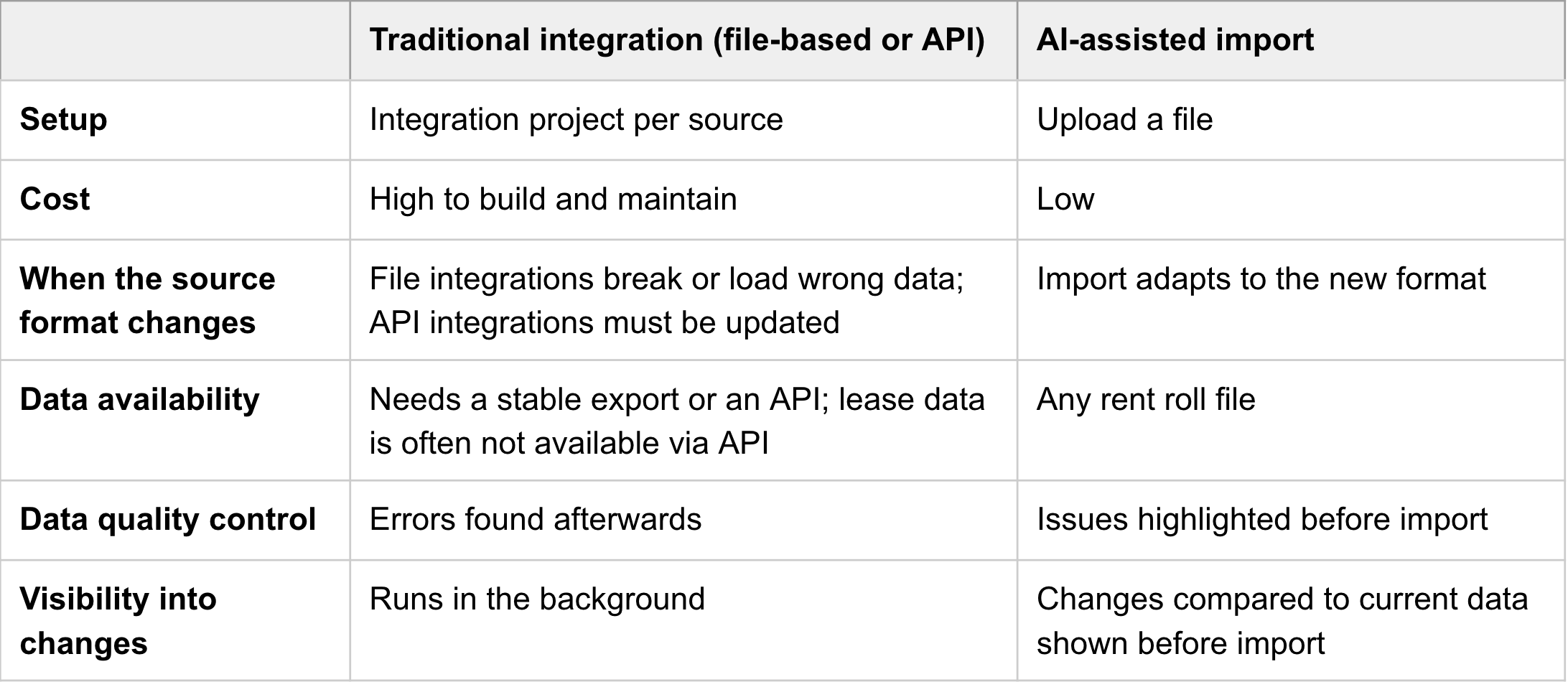
Integrations still have their place. If the source system offers a complete API and the data flow stays stable, an API integration can be a good choice. A file-based integration can work when a single source produces the same file for years.
Most asset managers and property owners, however, work with several property managers, each with their own systems and report formats. In that situation, building and maintaining an integration for each one quickly becomes expensive and fragile.
The AI-assisted import is built for exactly this situation. When Assetti cannot be the lease master, it is a great alternative to an integration. Any rent roll can be brought into Assetti without an integration project, and the user stays in control of what enters the system. The result is good-quality data that is easier and cheaper to keep up to date.
Does the AI save data into the system automatically? No. The AI processes the file and highlights possible issues and changes, but the user reviews the results before anything enters the system.
What happens if the rent roll format changes? The import interprets each file on its own, so a new column or a renamed header does not stop the import from working.
Do we need an integration project to get started? No. All you need is a rent roll file from your current system or property manager.


